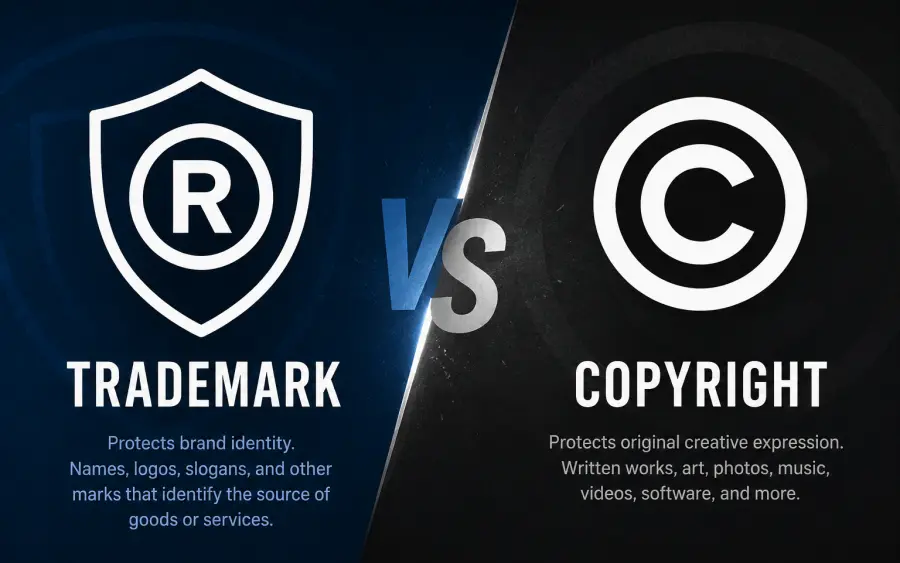
When comparing trademark vs copyright, the biggest difference is what each form of intellectual property is designed to protect. Trademarks generally protect branding that identifies the source of goods or services, while copyrights protect original creative works. For business owners and entrepreneurs, however, the distinction is not always obvious. A company may own trademarks protecting its name and logo while simultaneously owning copyrights in photographs, website content, advertisements, illustrations, videos, and other creative materials.
Understanding the difference between trademark and copyright can help businesses determine what parts of their intellectual property may be protected, which registrations they should consider, and what rights they may have when someone uses their intellectual property without permission.
Trademark vs Copyright: What Is the Main Difference?
The simplest way to understand trademark vs copyright is that trademarks generally protect brands, while copyrights protect original creative expression.
The United States Patent and Trademark Office (USPTO) explains that a trademark can be a word, phrase, symbol, design, or combination of these things that identifies goods or services. Trademark law is therefore closely connected to the identity of a business and the way consumers recognize the source of particular products or services.
Copyright serves a different purpose. According to the U.S. Copyright Office, copyright protects original works of authorship once they are fixed in a tangible form of expression. This can include photographs, illustrations, books, music, movies, computer programs, blog posts, and many other forms of creative expression.
Consider a company selling a new line of clothing. The company's name and logo may function as trademarks because they tell consumers who produced the clothing. An original illustration printed on one of the shirts, however, may qualify for copyright protection. As a result, a single product or business can involve several different forms of intellectual property protection at the same time.
What Does a Trademark Protect?
A trademark protects branding that distinguishes one source of goods or services from another. Business names, brand names, product names, logos, and slogans are among the most common examples of potential trademarks. In some circumstances, distinctive product packaging, colors, sounds, or other source-identifying features can also function as trademarks.
Trademark protection is closely connected to how a mark is used in commerce. Registering a trademark does not necessarily give a business exclusive rights to a word or phrase for every possible purpose. Instead, trademark rights generally relate to the particular goods or services associated with the mark.
For example, two businesses may sometimes use similar names when they operate in unrelated industries and consumers are unlikely to believe the businesses are connected. Similar marks used for closely related products or services, however, can present a greater risk of consumer confusion.
This is one reason businesses should conduct a trademark clearance search before investing heavily in a new brand. A search can help identify existing applications and registrations that could interfere with a proposed trademark. Businesses interested in federal registration can learn more in our guide on how to register a trademark.
Federal registration can provide trademark owners with significant additional protections. Among other benefits, the USPTO explains that federal registration can provide a legal presumption of ownership, public notice of the owner's claim to the mark, and the right to use the ® symbol in connection with the registered goods or services.
What Does Copyright Protect?
Copyright protects original creative expression rather than the commercial identity of a brand. Copyrightable works can include photographs, illustrations, videos, written articles, music, graphic designs, software code, and certain original website content.
Copyright protection generally begins when an original work is created and fixed in a tangible medium. A photographer, for example, does not ordinarily need to register each photograph before copyright can exist in the work. Registration with the U.S. Copyright Office, however, provides important additional benefits when enforcing those rights.
Copyright also does not protect every idea someone develops. The U.S. Copyright Office explains that copyright does not protect ideas, procedures, processes, systems, methods of operation, concepts, principles, or discoveries. Instead, copyright may protect the particular original expression of an idea.
This distinction can be particularly important for businesses creating marketing materials. A competitor may be able to use a similar general marketing concept without necessarily committing copyright infringement. Directly copying another company's original photographs, graphics, videos, or written copy presents a very different issue.
New technologies have made these distinctions increasingly important as well. Businesses incorporating artificial intelligence into their creative processes should consider how copyright law may apply to the material being used and produced. We discuss some of those concerns further in our article on AI copyright infringement risks for businesses.
Can Trademark and Copyright Protect the Same Thing?
Trademark and copyright can sometimes protect different aspects of the same intellectual property.
A company logo is one of the clearest examples. If a logo contains sufficient original artistic expression, the design may potentially qualify for copyright protection. When the same logo is used to identify the source of a company's goods or services, it may also function as a trademark.
The protections exist for different reasons. Copyright protects the original creative expression contained within the design, while trademark law protects the logo's function as an identifier of commercial source.
This overlap frequently appears in intellectual property disputes involving branded merchandise. A product containing another company's logo and copyrighted artwork, for example, could potentially raise both trademark and copyright issues.
These overlapping rights are particularly common in lawsuits involving entertainment companies and online sellers. Our coverage of the Amazing Digital Circus lawsuit and the DC Comics Schedule A lawsuit provides examples of how intellectual property owners can assert multiple forms of protection against allegedly unauthorized merchandise.
Trademark vs Copyright for Business Names and Logos
The trademark vs copyright distinction becomes especially important when protecting a business name or logo.
Business names generally fall within the realm of trademark law rather than copyright law. The U.S. Copyright Office explains that names, titles, slogans, and short phrases are generally not protected by copyright. A business seeking to protect the name consumers associate with its goods or services should therefore consider trademark protection rather than relying on copyright.
Logos can be more complicated because they can potentially involve both forms of protection. A relatively simple logo may function as a trademark without containing enough original creative expression to qualify for copyright protection. A more elaborate original design, however, may potentially qualify for copyright protection while also functioning as a trademark.
This is why businesses should consider the purpose and characteristics of each asset rather than assuming that a single type of intellectual property registration protects everything associated with their brand.
How Does Trademark vs Copyright Apply to Product Packaging?
Product packaging provides another useful example of the relationship between trademark and copyright law.
Original illustrations, photographs, or graphic designs appearing on packaging may qualify for copyright protection. At the same time, the overall appearance of packaging can potentially receive protection under trademark law when it functions as an identifier of source.
This type of trademark protection is commonly known as trade dress. Trade dress can potentially protect distinctive elements of a product's packaging or overall presentation when those features identify the source of the product and satisfy the applicable legal requirements.
We discussed this form of protection in our article on the Van Leeuwen trade dress lawsuit, which involved allegations surrounding the distinctive appearance of ice cream packaging.
For businesses, this demonstrates why identifying intellectual property should extend beyond simply asking whether a company name has been registered. Packaging, artwork, photographs, logos, product names, and other brand assets can each raise different intellectual property considerations.
Trademark Registration vs Copyright Registration
Trademark and copyright registrations are handled by different federal agencies and follow different processes.
Federal trademarks are registered through the United States Patent and Trademark Office. An applicant must generally identify the trademark and the particular goods or services with which the mark is or will be used. The application then undergoes examination by the USPTO.
Before filing, businesses should evaluate whether conflicting trademarks already exist. The existence of an earlier confusingly similar mark can create problems during the application process and may also expose a business to infringement claims.
Copyright registrations are handled by the U.S. Copyright Office rather than the USPTO. Although copyright generally exists automatically when an eligible original work is created and fixed, registration provides important enforcement benefits. For U.S. works, registration or refusal of registration is generally required before a copyright owner can file an infringement lawsuit in federal court.
The U.S. Copyright Office's Copyright Basics provides additional information regarding copyright ownership, registration, duration, and the works that may qualify for protection.
How Long Do Trademark and Copyright Protections Last?
Another major difference between trademark and copyright is the duration of protection.
Trademark rights can potentially continue indefinitely. Federal trademark registrations must be maintained, and the mark must continue to satisfy the requirements for trademark protection. When properly maintained and continuously used, however, a trademark can remain protected for generations. Some of the world's most recognizable trademarks have been used for more than a century.
Copyright protection operates differently because copyrights generally have a defined term. The exact duration depends on factors including when the work was created, who created it, and whether it qualifies as a work made for hire. We cover this in more detail in our article on when copyright expires.
For many works created by individuals today, copyright generally lasts for the life of the author plus 70 years. Different rules can apply to works made for hire, anonymous works, pseudonymous works, and older works.
Businesses should therefore avoid assuming that all forms of intellectual property expire or require maintenance in the same way.
Trademark Infringement vs Copyright Infringement
Trademark infringement and copyright infringement also involve different legal questions.
Trademark infringement generally focuses on whether another party's use of a trademark is likely to cause confusion regarding the source, sponsorship, affiliation, or approval of goods or services. Courts can consider several factors when determining whether consumers are likely to be confused.
Copyright infringement generally concerns the unauthorized exercise of rights belonging to the copyright owner, such as reproducing, distributing, displaying, or creating derivative works from protected material, subject to applicable exceptions and defenses.
For an e-commerce seller, both types of allegations can arise from the same product. A seller offering unauthorized merchandise featuring a company's trademarked logo and copyrighted character artwork, for example, could potentially face both trademark and copyright claims.
This is frequently seen in Schedule A litigation targeting online sellers. Rights holders may assert multiple intellectual property claims when products allegedly incorporate both protected branding and creative works. Businesses selling through online marketplaces should therefore understand what intellectual property appears on the products they source and sell — a recurring issue for Amazon sellers facing IP complaints.
Do Businesses Need a Trademark, Copyright, or Both?
Whether a business needs trademark protection, copyright protection, or both depends on what the business owns and what it is trying to protect.
A company primarily concerned with protecting the name consumers use to identify its business or products may want to prioritize trademark protection. A company that regularly creates original photography, artwork, videos, written materials, software, or other creative content may also have valuable copyright interests.
For many companies, the answer is ultimately both.
A business's intellectual property portfolio may include trademarks covering its name and logo, copyrights covering its photographs and advertisements, and additional intellectual property rights involving trade dress, trade secrets, patents, or other assets.
Instead of simply asking whether a company needs a trademark or copyright, business owners should consider a broader question: What intellectual property does the business own, and what type of protection applies to each asset?
Understanding Trademark vs Copyright Protection for Your Business
Understanding trademark vs copyright can help businesses identify and protect valuable intellectual property before a dispute arises. Trademarks generally protect the branding that identifies the source of goods or services, while copyrights protect original creative expression. Depending on what a business creates and sells, both forms of protection may play an important role.
Understanding these distinctions can also help businesses avoid accidentally infringing the rights of others. Before launching a new brand, publishing creative content, selling merchandise, or expanding an existing product line, businesses should consider what intellectual property rights may already exist and what protections they may need for their own assets.
If you have questions about trademark registration, copyright protection, or an intellectual property dispute, Stockman & Poropat, PLLC can help you evaluate the intellectual property involved and determine the appropriate next steps. Contact the firm to schedule a consultation.
Have a question about your matter?
Schedule a free consultation with Stockman & Poropat, PLLC.
Contact the firm